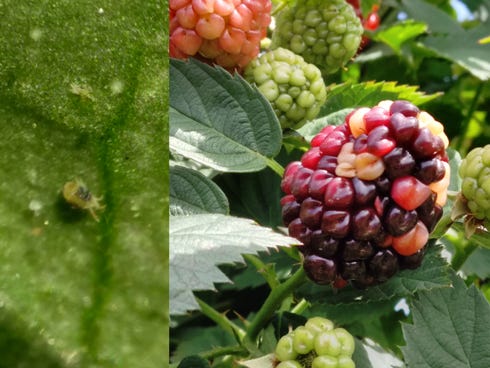

Plenty of insects and their relatives can damage our crops and landscape plants, but few are tinier than mites.
Mites are actually arachnids, closely related to spiders and scorpions. While insects are characterized by having six legs and two pairs of wings, arachnids have eight legs and no wings (thank goodness — I’d rather not have spiders flying around, thank you very much).
There are many kinds of mites, some of which can be helpful and some of which are harmful.
The helpful ones are predators that hunt and kill the harmful ones for food. Some of these species can be purchased to release as biological controls for pest problems.
Some of the most common harmful mites are spider mites, such as the two-spotted spider mite. They like hot, dry weather, feed on a wide variety of plants, and often hang around the underside of leaves, which (along with their small size) can make them difficult to spot.
It’s easier to find the damage the mites cause than looking for mites themselves. Two-spotted spider mites feed by sucking fluid from plants, and they leave tiny marks on the leaves that show up as yellowed areas, which look mottled or stippled. Largeinfestations also leave fine webbing on the leaves and stems they inhabit.
Another variety of harmful mite is the redberry mite, which also can leave damage. The mites themselves can be difficult to find, as they are quick and hide in fruit's cracks and crevices.
These pests can be controlled with predacious species of mites, or with chemical treatments. Miticides are available that target pest mites, and horticultural oils such as neem can be applied to most plants to get rid of mite problems.
Evan Anderson is an agent at the University of Florida's Institute of Food and Agricultural Sciences Extension office in Crestview.
This article originally appeared on Crestview News Bulletin: ANDERSON: Mites can be helpful or harmful