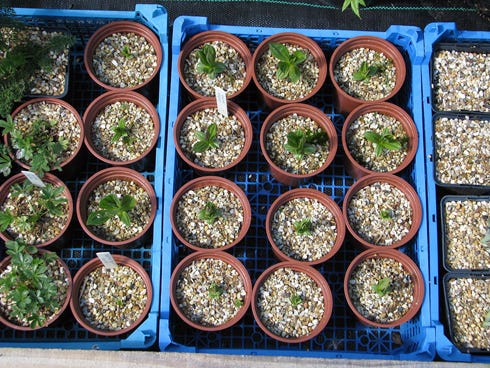

Some plants in my landscape provide fond memories — those are plants that I propagated.
For instance, there’s a mulberry tree in my backyard that I rooted years ago. I took cuttings from an old mulberry tree in my hometown.
As a boy, I climbed the tree; got in trouble once for coming home with mulberry stains on my clothes. I liked the berries; still do.
I have good childhood memories about that tree.
About 20 years ago, I visited the property adjacent to my childhood home during mulberry season. The tree was still there, so I took about eight or 10 cuttings and enjoyed a few mulberries.
About a year after my visit, the property was sold and the new owner bulldozed the tree. But because of the cuttings that I rooted, the tree still lives — not just in my memory.
Trees produced by those cuttings are genetically the same as the parent tree. Essentially, they are clones. The one in my backyard produces mulberries each year.
You, too, can propagate memories.
Not all plants can be propagated from cuttings, but many can be. Sometimes, trial and error is necessary to learn proper timing in taking cuttings. But most reliable references will provide the time of year to take cuttings.
After making that determination, follow these steps:
1. Remove stem cuttings from the parent plant with a clean, sharp knife or pruner. Your cutting should be 4 to 6 inches long, and not much thicker than a pencil in diameter.
2. Remove the bottom two-thirds of leaves on each cutting. Then, stick the cuttings upright in a propagation medium. I usually use a good-quality potting mix and mix in a little coarse sand or perlite for better drainage. Insert the cuttings deep enough to hold them upright; that's usually ½ to 1 inch.
3. Wound the cuttings.Scrape the lower ½ to 1 inch of the stem with a clean, sharp knife. The scrape should remove the bark or “skin.” This should help promote rooting of moderate- to difficult-to-root plants.
4. Dip the cutting in a rooting hormone. Cover the scrape with the rooting powder before inserting the cutting into the rooting medium.
You can use a 4-inch or 1-gallon pot, or a bedding plant flat with drainage holes, as a rooting container. I may stick as many as 10 stem cuttings in a gallon-size pot.
Place the container of cuttings in a shady location outdoors and keep it moist. Cuttings should produce roots in two to 16 weeks, depending on plant species and the environment.
After cuttings have rooted, carefully remove them and plant each rooted cutting in its own 4-inch or gallon-size pot.
Keep the potting medium moist but not soggy.
After roots adequately fill the pot, cuttings should be strong enough to be planted in the ground.
As your rooted cuttings grow, hopefully they will provide fond memories.
Larry Williams is an agent at the University of Florida's Institute of Food and Agricultural Sciences Extension office in Crestview.
This article originally appeared on Crestview News Bulletin: WILLIAMS: You can propagate memories